
The term “project management” is surprisingly hard to define in a way that doesn’t become self-referential or completely meaningless. It means different things in different contexts, meaning that the definition is quite slippery. I’m still trying to figure it out myself, and I’m a qualified project manager and member of the APM.
It’s a constant source of bemusement and annoyance that my peers seem to spend so much of their time doing different things. Surely if we are all project managers in the same industry, in the same company even, then we should all have equivalent skillsets and need to solve equivalent challenges?
The last time I wrote something like this, I defined operations management in fanciful terms by reference to other professions. In this article, I’m going to concentrate on the differences between project management and related fields. In doing so, I accept that I’ve ruined any chance of search engines finding this article … who is ever going to search for a definition of what a subject isn’t?
I’ll look at defining what is a project and use that to support a definition of project management – including the skills and capabilities needed to successfully manage a project. I will then compare project management against similar roles and functions in an organisation. I will finally introduce the concept of the project management Body of Knowledge, or BoK.
Here’s one way to define project management:
I’m a project manager. I manage projects.
Stacey C, real-life project manager
In some ways, this is an entirely adequate definition. Even in a small, one- or two-person project, somebody is responsible for successfully delivering the project; they are, de facto, the project manager. Very often, it makes sense for the most senior technical person to be the project’s leader, even if there is also a project manager in support. Other times, the project manager takes an active role in directing the project.
However, this definition is also thoroughly frustrating. First, we need to define what a project is.
What is a project?
There are infinite ways to define project. Perhaps we can hone in on the key characteristics.
An individual or collaborative enterprise that is carefully planned to achieve a particular aim
Oxford Languages / OUP
I find this definition immediately questionable, at least in the professional sense of a project. Are all projects “carefully planned”? Many people would consider tidying their garden to be a project, even if the planning revolves more around the reward of a cold beer at the end of the day.
And while it’s true that projects have a purpose, that purpose doesn’t have to be a singular “particular aim”; they can result in a range of benefits, some of which may be realised long after the project has finished.
A temporary endeavour with a fixed start and end date. It’s an initiative with a unique product or service that has specific goals and objectives that a project manager and their team fulfil.
The Digital Project Manager, quoting from the PMI Body of Knowledge
Some of the key characteristics of a project are starting to emerge here. A project is bounded in time: if there’s no intent to finish it, then it’s not a project. It is unique: if you are repeating the same task in the same way over and over, then it’s not a project.
a set of tasks that must be completed within a defined timeline to accomplish a specific set of goals. These tasks are completed by a group of people known as the project team, which is led by a project manager, who oversees the planning, scheduling, tracking and successful completion of projects
ProjectManager.com
These successively more detailed explanations do identify the most important characteristics of a project, but none of them so far have mentioned one of the most important aspects of all: change. Projects are entirely about change: creating something new, or modifying the way things are done.
By contrast, operations refers to maintaining the steady state or a regular business rhythm. In an operations context, change is bad; the aim is to keep things humming along within very narrow parameters.
We can draw together all of the definitions above in an attempt to summarise the specific attributes of a project.
A project is a unique change, implemented by a temporary team working within constraints and uncertainty, intended to deliver benefits.
Now that we know what constitutes a project, we can better define the attributes of the people whose job is to manage projects.
What is project management?
Project management is the application of processes, methods, skills, knowledge and experience to achieve specific project objectives according to the project acceptance criteria within agreed parameters. Project management has final deliverables that are constrained to a finite timescale and budget.
A project professional needs a wide range of skills; often technical skills, and certainly people management skills and good business awareness.
Association for Project Management
There’s a fair amount of jargon in the APM’s definition of project management, but read it closely and it’s possible to trace the necessary skills of the project manager back to the unique challenges of a project, as we defined above.
When I first moved from operations management into project management, one of my mentors told me this:
If you can boil an egg, you can manage a project
Rob R, actual senior delivery manager
In retrospect, it’s not entirely clear whether he was trying to discourage me. However, with the benefit of several more years of experience, I have to disagree with Rob’s assertion. Does boiling an egg meet the definition of a project?
I do understand what he was getting at. If supported by appropriate methodologies and policies, then anyone with the right temperament and certain basic organisational skills could become a successful project manager. However, it’s important to note that project management does require expertise and knowledge. There are, clearly, good project managers and bad project managers; there are successful projects and failed projects. If it were possible to produce a framework of templates that guaranteed project success, then we would certainly have found it by now.
What do project managers actually do?
In some types of business, almost everything is considered a project. In consulting / engineering businesses, every individual client engagement meets the definition of a project. It’s perhaps less obvious that much of the internal work of a company is also arranged into projects. A change to an internal process is a project. Reconfiguring or refitting an office space is a project. Adding a new approved supplier is a project. So much of the business is organised around projects that the operational aspects are often siloed into a single supporting function that together comprises finance, facilities management, legal, HR and the other bits of organisational glue.
One widespread assumption is that project management is a direct synonym for schedule management. It has been this way for a very long time:
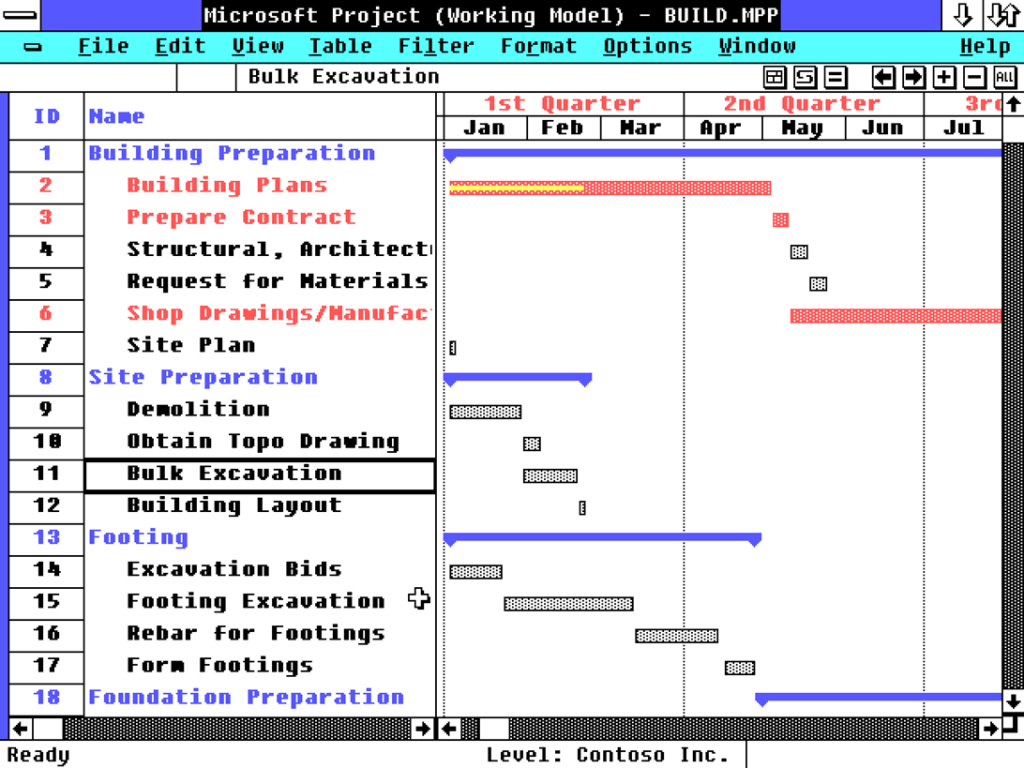
That’s a Gantt chart drawn in Microsoft Project, more than thirty years ago. In terms of the software’s look and feel, not very much has changed since, even if the complexity and sophistication have increased somewhat.
A Gantt chart is probably the tool that popularly differentiates a project manager from any other kind of manager. It shows how scheduled tasks fit together with constraints between them. For example, some task cannot start until some other task has successfully completed. MS Project also deals with cost management, and with resource levelling: that is, keeping available resources as busy as possible to avoid bottlenecks and downtime. It can also construct project networks, showing the relationships between tasks, the critical path, and the amount of contingency time, known as slack or float, that exists within each part of the network.
Still, it’s the Gantt that is the most common visual depiction of how a project’s tasks relate to one another, especially for people who consider projects to consist largely of a to-do list of tasks and subtasks to be undertaken in a set sequence, with gates or milestones between them. And so this has become the dominant shorthand for what a project manager does, even though most modern projects aren’t managed this way and even though scheduling is only one narrow aspect of the project manager’s role.
We saw earlier that a project is defined with respect to certain constraints. It’s often stated, glibly, that any project can be “cheap, fast, or good – but you can only pick two.” These three aspects (cost, time and quality) are sometimes known as the project management triangle. The quality aspect is usually understood to mean how well the project meets its requirements. In fact, it’s often helpful to consider quality as being two separate dimensions of a project. There’s scope – the set of things that the project is intended to deliver; and quality in the plain-English sense of how good something is – how robust, how well-engineered. Some illustrations of the iron triangle, or golden triangle, or PM triangle, include one or other of these dimensions at the triangle’s centre. I’d argue that it has ceased to be a triangle at this point.

We can also visualise a project’s constraints in terms of the various inputs available to us. The balance of these inputs will tend either to help or hinder the project’s goals.
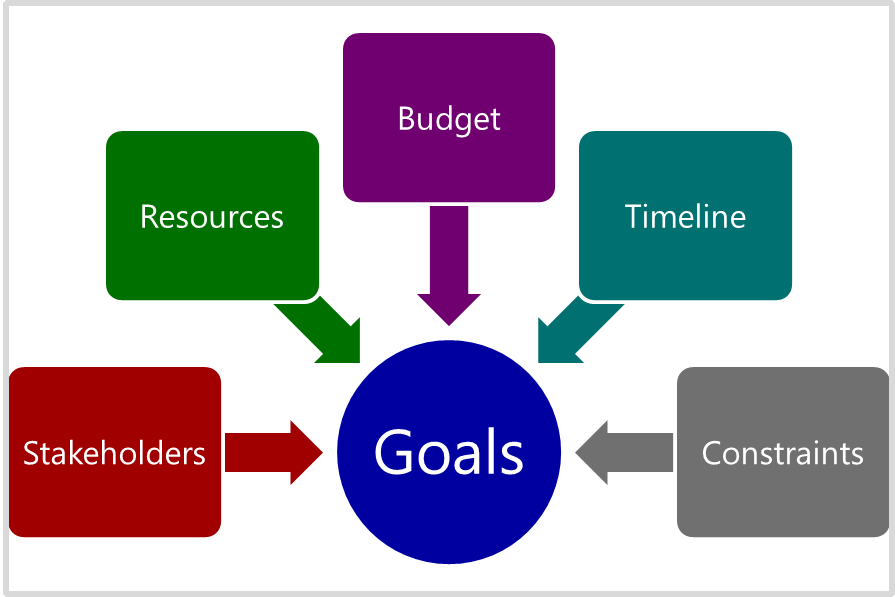
In this context, constraints may include any number of non-functional requirements that act as guard-rails or limits on the project. These may be imposed by the delivering organisation, its customer, or the wider operating environment. The latter is sometimes referred to as PESTLE, referring to the project’s context within external factors that are:
- political;
- economic;
- social;
- technological;
- legal; and
- environmental.
It’s the project manager’s responsibility to track and manage all of these. Now schedule management seems like quite a minor part of the job description.
Project management isn’t operations management
We saw earlier that organisations can divide all of their work into either projects or operations. Sometimes the line between the two is blurry. What, for example, is the difference between the following two manufacturing tasks?

A production line of cans of beans is operational: it is defined by its unchanging nature. Every can of beans should be identical to every other, within certain narrow tolerances. By contrast, a change to the production line – perhaps a tweak to the recipe, or the marketing – would constitute a project.
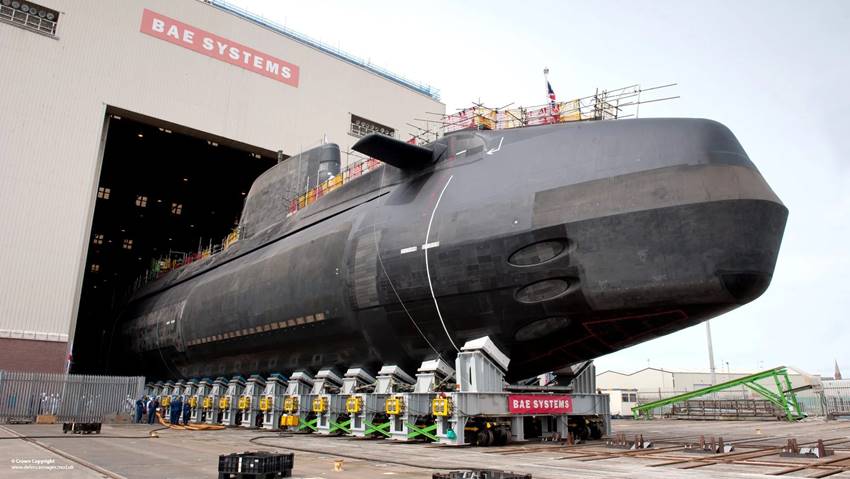
This is an Astute-class submarine prior to launch at Barrow-in-Furness. It is one of a fleet of eight. Apart from its size and scale, the manufacture of a submarine is very definitely a project. Each submarine may start off identical, like the cans of beans, but its design and construction will evolve substantially over the lifetime of the programme. This is true of both the technologies integrated into the design, and the process of construction itself.
This shouldn’t be a huge surprise. The Astute programme is decades old. There is at least one employee in the Project Management Office who joined the programme as an apprentice, has risen to a senior management role, and will retire before the final boat is completed. Over this time period, of course the team will identify many opportunities for improvements: changes.
Project management isn’t engineering management
Once upon a time, it was accepted wisdom that any engineering project of moderate complexity would be managed using a method called waterfall. Each stage of the process is separated by a series of reviews, or gates, between them, and a matching set of assurance and validation activities.
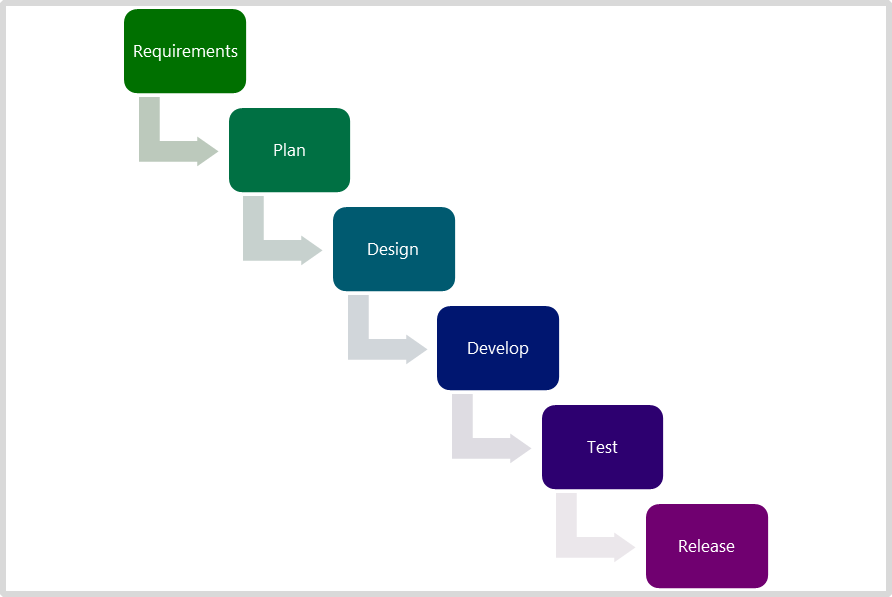
Waterfall has the advantage of rigorous adherence to project requirements and quality. Every step is validated and agreed by the stakeholders. However, it has some very serious drawbacks for some types of projects. In particular, it doesn’t deliver any customer value until the very last stage. And if any problems emerge – perhaps a missing mandatory requirement – then the fix may be expensive and time-consuming.
Subsequently, agile methodologies became more popular in many engineering domains, especially software development. Agile has the advantage of value being added incrementally. The customer can receive a minimum viable product much earlier than they would under waterfall, and then improve the product over time.
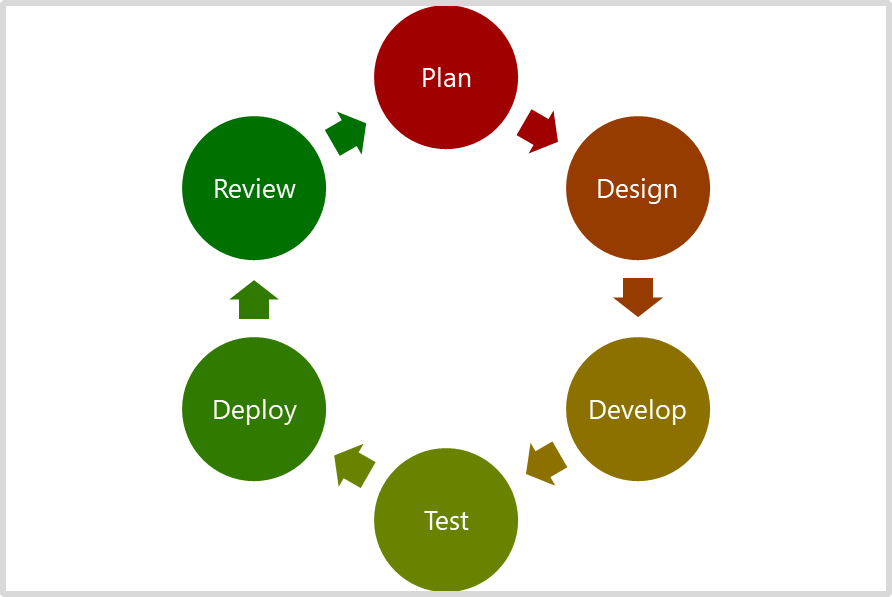
While the waterfall engineering methodology has similarities with the project management approach we discussed earlier – a series of gated stages – the two are actually independent of each other. An agile project is still a project. Even if the engineering team perceives it as a self-managed cycle of incremental improvements, the fact is that it almost certainly exists within a traditional project structure. It still has all the same stakeholder constraints and expectations of time, cost, scope and quality. (An exception might be a DevOps development process which, as the name suggests, has more operational than project characteristics.)
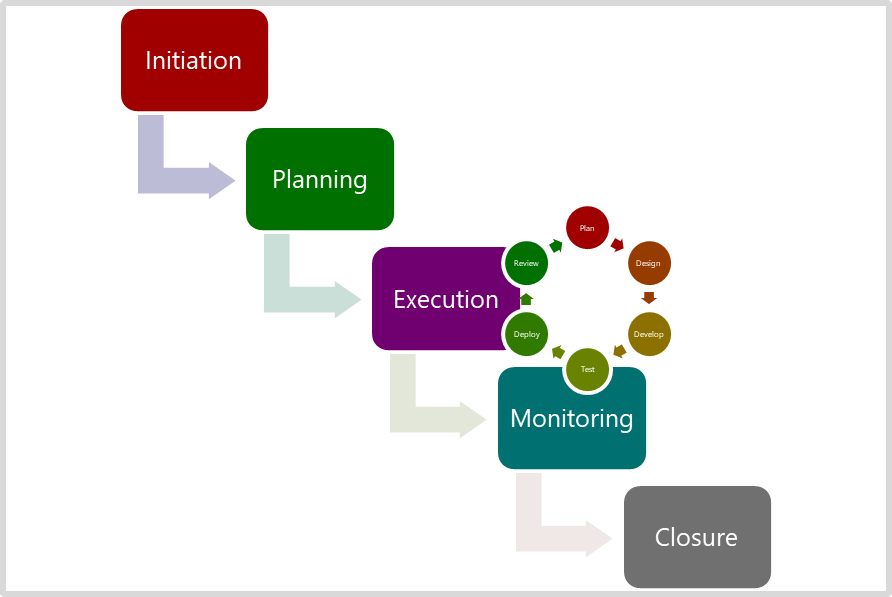
The engineering aspects of the project may well be managed by a dedicated engineering manager or agile coach, such as a Scrum Master. That doesn’t imply that the Scrum Master must also be the project manager; they are independent roles with complementary skillsets.
Project management isn’t programme management
Even though projects, programmes and portfolios are often bundled together – a “P3M function” – a programme really isn’t just a large project. A programme manager isn’t just a really good project manager.
A programme is a long-term framework that contains multiple projects (and operational aspects as well) which focuses on outcomes and benefits beyond the lifespan of a single project. It comprises:
co-ordinated projects and change management activities combined to achieve beneficial change.
Association for Project Management Body of Knowledge, 7th edition
Project management isn’t delivery management
The definition of delivery management is even more slippery than that of project management. Typically, a delivery manager has an enduring role and a long-term relationship with the customers and stakeholders. They focus on the delivery of products and services to the customer’s satisfaction. They may stand-up new project teams as required, and they may also have a role in resolving problems that arise within a project.
The term delivery manager may also be used for tasks that are project-like, but which can’t be called projects. For example, if a company decides to make a number of employees redundant, then this process does, unfortunately, need to be managed as a project; yet it would be inappropriate and insensitive to describe it as such.
Project management isn’t the PMO
Project managers may be appointed within a project management office, working alongside specialist project professionals, such as experts in risk management. However, that doesn’t mean that the project manager is necessarily a part of the PMO.
There are several types of PMO which interact with project managers in various ways:
- A supportive PMO is one that maintains best practices, tools and templates in support of project managers. Engagement with this type of PMO is optional; for example, a larger project may seek more support than a smaller one.
- A controlling PMO is one that enforces minimum standards. It provides a framework or methodology, and policies and procedures, that form a mandatory set of controls that the project manager must adhere to.
- A directive PMO is one that sets strict standards, measures and controls.
Project management isn’t project administration
Large projects often require a huge amount of organisation and record-keeping.
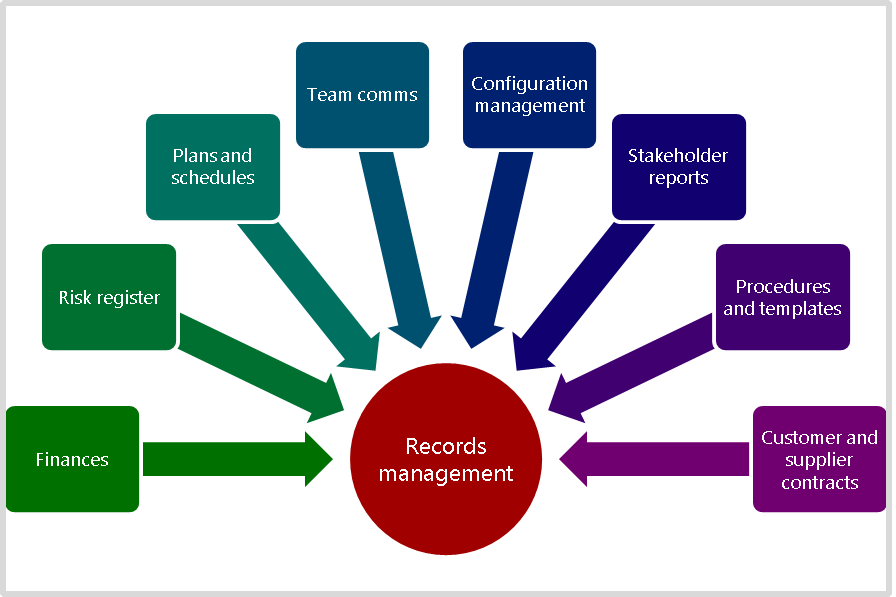
It is usual to have one or more separate administrators to handle this, either directly supporting the project manager or delegated to a project management office.
As a manager on relatively small projects, I like and enjoy doing my own record-keeping. It helps me to keep all of the salient facts at my command, and it gives me a first line of assurance against external mistakes (such as a company data source containing incorrect information).
Project management isn’t project control / audit
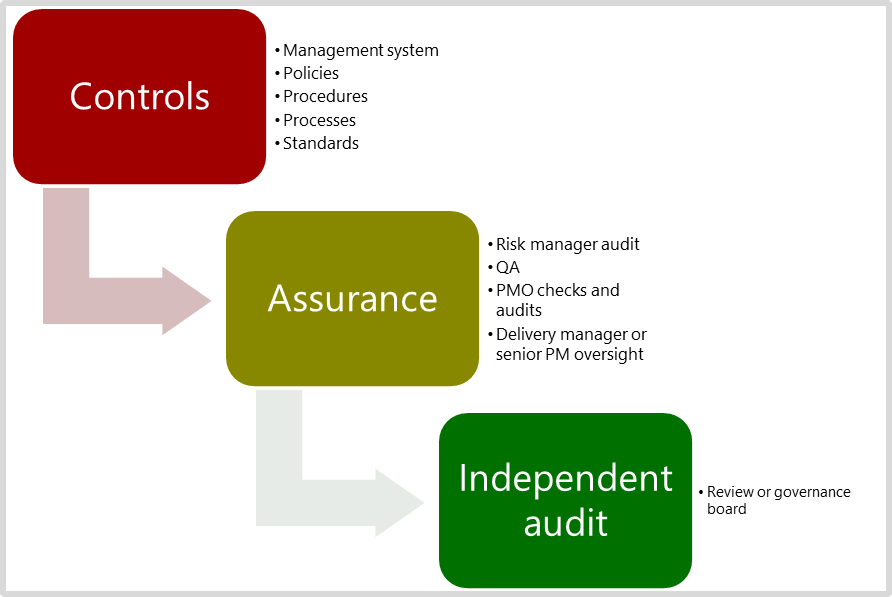
Even the best-run project will need some level of governance and assurance, independent of the project manager.
The project manager often forms the “first line of defence” in ensuring the project’s success, by using their own expertise to establish appropriate day-to-day project controls. A second line of defence is provided by an assurance process; and then a third line by an independent auditor.
Project management isn’t (just) construction management
In the engineering profession, it’s been a bone of contention for years that the term engineer is not well understood by the community at large. More accurately, the term engineer is overloaded: it means different things to different people. A professional mechanical engineer isn’t the same thing as a washing machine engineer, no matter the superficial similarity in expertise and title. And that’s before we even consider the spectrum of different types of engineering: civil, electrical, software, chemical. However, there are engineering skills that remain applicable across even this broad range of professions.
The same is true of project manager. This is never more clear than when comparing the role between different industries. There are certainly project management skills that are consistent between all industries and project types; there are also industry-specific skills – especially applicable quality and safety standards – that are not transferable between disciplines.
Taken to extremes, project management means whatever the speaker wants it to mean. A digital artist working in a project context may seek out a suitable project management tool, but it’s unlikely that they intend something like the Gantt charts of MS Project. Rather, they will need a tool that manages individual task tickets (like Trello), and maybe something that manages the assets related to each project.
There is real danger in using the term project manager to mean something that it isn’t. The enquiry into the Grenfell disaster was particularly scathing around the role of the renovation’s project managers. But that’s partly because nobody was really clear what the role of the project manager actually was – nor any other essential project roles. In particular:
- When the enquiry tried to find the responsible project managers from some of the suppliers implicated in the disaster, they were directed to people with no real project accountability. Instead, these staff held the job title of Project Manager but were actually responsible only for snagging lists, or for site management.
- The TMO-appointed project manager was found to be hopelessly under-qualified for such a complicated project.
In many walks of life, projects need managing but it’s not always clear whether that really requires an actual project manager. Particularly in organisations that are heavily resource-constrained, such as charities, projects will be managed by a volunteer, or by someone whose day job isn’t in project management. The risk is that they don’t recognise when they are out of their depth. They are keen amateurs who hold a personal stake in the project’s outcome, but that’s not always sufficient to ensure success.
We have to avoid making assumptions about project management. We have to stop assuming that any honest and keen stakeholder will automatically have the skills to deliver a complex project successfully.
And we especially have to stop assuming that other people will know what we’re talking about when we post something like this to the UK’s top recruitment website:
Our client are global leaders in their field! They are recruiting for a Programme Manager who will be the primary interface with the customer and is responsible for managing all operational aspects and related financial aspects of the assigned customer account.
The ideal Programme Manager will have degree or equivalent work experience in directly related fields, with a thorough knowledge of the customer and their market.
Found on Indeed.co.uk, March 2025
That’s a real job advert for a programme manager role in, it would seem, a heavily-regulated and specialist industry. Alas, we have no idea which industry.
Professional bodies
We now tend to understand project management to be a profession. Project managers can achieve internationally-recognised qualifications and can work towards chartership or fellowship – just like other professions such as engineering, law or finance.
Being a professional confers certain responsibilities on individual project managers as well: for example, we are supposed to uphold professional ethics and to maintain our professional knowledge. We have moved beyond project management being an activity undertaken in the margins of another job role.
In the UK, the chartered professional organisation is called the Association for Project Management (APM). Internationally, a similar role is filled by the Project Management Institute and International Project Management Association.
Body of Knowledge
The APM and other professional bodies maintain professional standards for all types of project. They do this by providing training and issuing transferable qualifications. They also maintain a library of specialist resources, such as tools, templates and best-practice guidance. These resources exist within a framework called the Body of Knowledge: the complete set of project management skills.
The APM publishes its Body of Knowledge in the form of a slim single-volume book. The book doesn’t purport to teach every project management topic in detail. Rather, every two or three pages provides an overview of a single project management skill or competence, each with a bibliography suggesting authoritative sources of further knowledge.
The APM is about to release the 8th edition of its BoK in April 2025 and is likely to reorganise the way it groups the topic areas. Here are the major topics covered in the 7th edition:
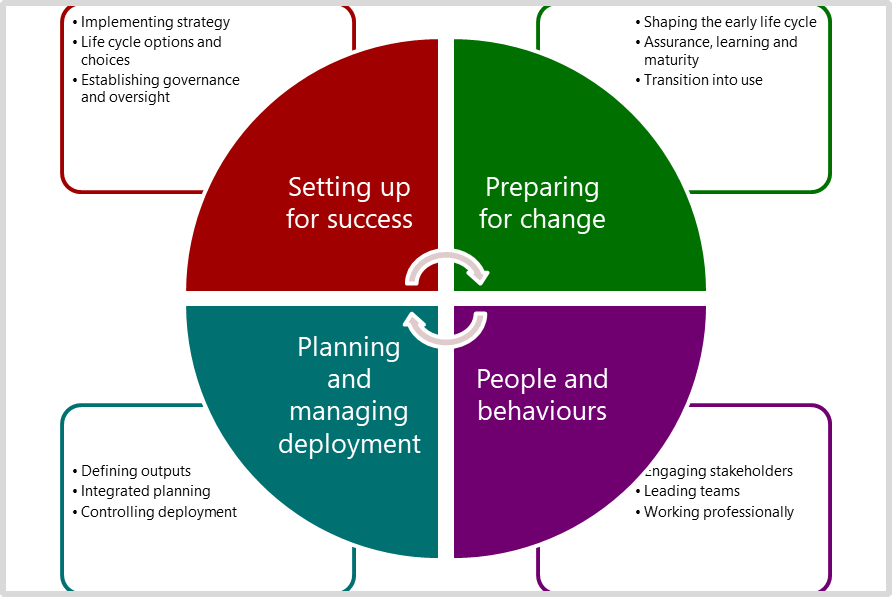
These mundane-sounding headings cover a complex swathe of specialist disciplines; the BoK has a surprisingly broad scope. Here are the individual topics within one of the areas:
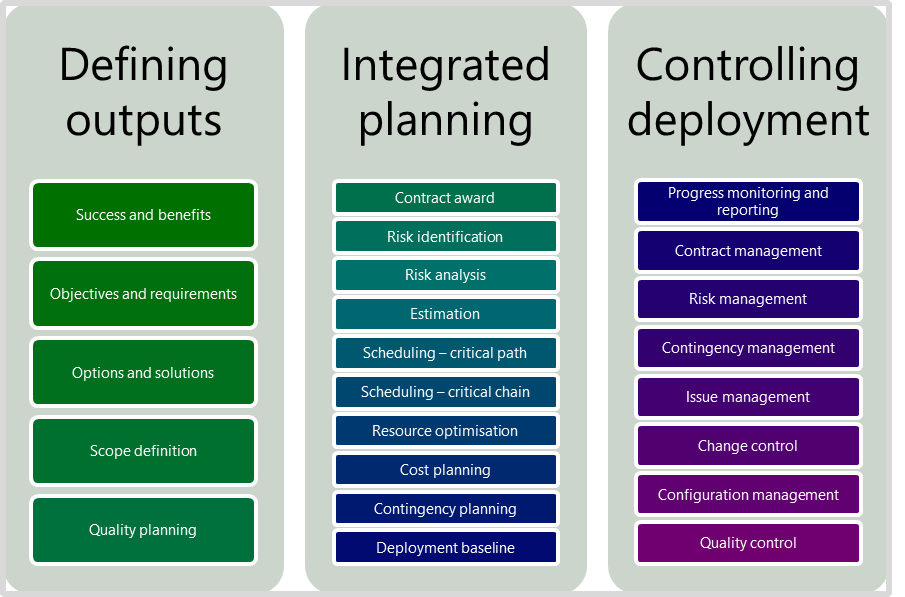
Right at the start of this article, we saw that scheduling is the classic project management skill. But now we can see that project management is far more broad than this.
Of course, not every project will need all of these skills. And on larger projects, the project manager may not even have relevant skills in all of these areas; they may, instead, be able to draw upon specialist knowledge from their project management office.
It is customary for a project manager to begin a project by writing a Project Management Plan, or an Integrated Management Plan. This is a document that sets out the intended approach to each area. For a small project, this may be as simple as a few pages setting out the shape of the project team, the high-level schedule, and the approach to maintaining quality. For complex projects, the plan may run to hundreds of pages of detail. It may also refer out to reams of supporting documentation: schedules; task estimates; cost budgets; risk registers; quality certificates; configuration management logs … all of the artefacts needed to control the successful delivery of the project.
Summing up
- A project is a unique piece of work, delivered by a temporary team. It is either led or supported by a project manager.
- Project management is a profession requiring a broad range of skills, depending on the size and scope of the project.
- Project management is adjacent to, but distinct from, other business roles.